Turning Depression Into an Indomitable Spirit

The Koreans have the “indomitable  spirit”  as their fifth tenet of Tae Kwan Do.  Young students learning martial arts learn to confront their weaknesses and turn them into areas of strength.   Like the African word “kente” meaning that which cannot be broken, a strong spirit has never been more needed than it is today.   Both terms describe an inner strength that all students can learn—and need to learn—to tackle tough challenges for themselves and others and to make the world a better place.

Over the last ten years, the number of students with severe mental illness has increased more than 10 percentage points, according to the American Psychological Association. In a recent NPR story, “Depression On The Rise In College Students,” health experts said a large part of this increase is due to more effective counseling being implemented in younger school-age students. By the time these students are getting to college, they have already been diagnosed and are seeking help from the college to manage their learning disabilities or emotional problems. But are we over-diagnosing students with depression, anxiety, and learning disabilities? Is the rising number of prescribed students due in part to increased availability of problem-solving pills? While there are certainly situations that require medication, are there still many others where meds are a default used instead of working through emotional problems with the same perseverance required to succeed at math?

In Ken Robinson’s TED lecture, “Changing Education Paradigms,” he calls the increase in students getting diagnosed with ADHD a “fictitious epidemic.” Are students getting prescribed to focus or punished for being bored in a boring class? New generations are growing up in a multi-tasking, quick moving world that demands a 20 second attention span everywhere but the classroom. Many educators know technology will only become more engrained in all our lives and are looking for ways to engage students with a 21st Century experience. Is it possible that a large part of the 10 percent increase in mental illness are made up of students that don’t need a drug but need a change in location, a new peer group, a hobby, or someone to talk to?

Have students put their problems in perspective to see the change they can make independently of prescription drugs.  The rate of depression in other countries, where many students are working multiple jobs, going to school full-time and taking advantage of education as a way to improve the lives they came from, is much lower.  There is a connection between being busy, having goals and a purpose and succeeding emotionally, academically and socially.   Where do students see themselves in five years?  What obstacles will they need to overcome to make their dreams happen?  What failures and setbacks can make them stronger as people?   What would the person you want to become say to you today to encourage you out of a rut?   If we can help students build a strong spirit, we give them a tool to overcome a variety of problems.  Once they learn to solve their own problems, they can go on to solve some of the problems which the world needs them to solve.

Finally, for a closing perspective, watch Sir Ken Robinson’s RSA animated lecture, “Changing Education Paradigms.”

Share this Article with Your Friends:
  • Print
  • Digg
  • StumbleUpon
  • del.icio.us
  • Facebook
  • Yahoo! Buzz
  • Twitter
  • Google Bookmarks
  • LinkedIn
  • RSS

Teaching Students How to Say Good-Bye

By 4028mdk09 (Own work) [CC-BY-SA-3.0 (www.creativecommons.org/licenses/by-sa/3.0)], via Wikimedia Commons

As our nation mourns the victims of the tragedy in Tucson last weekend, students everywhere have the opportunity to reflect on the meaning of the lives that were lost and the implication that has for how they view  their lives from here on out. If teachers and parents allow time for students to take the emotional space to hold the pain of this experience, the healing can begin and the actions of those who remain can appropriately memorialize those who have died.

Cultures from around the world, from indigenous people to advanced societies, need to honor those who have died in ways that can pay tribute to them while giving us a firm way to lead our lives in a better way. Whether we honor the deceased with funerals, rituals, a lit candle, a prayer, a letter to remaining family members or a period of silence each person can bring meaning in their own way to incomprehensible tragedies like this. Teaching young people to feel the sadness, take steps to pay homage to those who have died and then to set their own course for right action is the only way to pay tribute to those courageous victims of our society whom we lost this week. Let’s challenge each young person as this week comes to a close and as family members hold services for their loved ones, to ask these questions:

  • What enduring qualities of those who have died can I carry forth in my own life?
  • What steps can I take in my own life to stand up for democracy, listen to opposing views and be respectful of all people’s opinions?
  • What other commitments am I willing to make in my life as  a tribute to those who have died?

Never send to know for whom the bell tolls.  It tolls for thee.    – John Donne

Share this Article with Your Friends:
  • Print
  • Digg
  • StumbleUpon
  • del.icio.us
  • Facebook
  • Yahoo! Buzz
  • Twitter
  • Google Bookmarks
  • LinkedIn
  • RSS

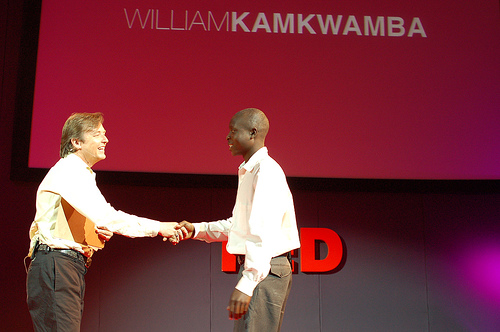
Friday Profile: Pioneering Young Leader, William Kamkwamba

Growing up in the African country of Malawi, William Kamkwamba witnessed poverty’s devastating effects. When a fierce famine hit in 2002, William was forced to leave school due to financial strains. Armed with curiosity and a vision of a better life for himself and his family, he did not let his absence from the classroom affect his desire to learn. William stumbled across a textbook on agricultural practices in the library. On its cover was a picture of a windmill. Knowing Malawi had plenty of wind, William soon had the vision of a windmill providing energy for his family. Unfortunately the book didn’t offer detailed instructions on how to construct a windmill, so he figured it out himself.

William was fourteen when he built his first windmill using discarded items from neighbors’ trash and scraping up money to buy a few essential pieces: a rubber belt, a bike chain ring, a bicycle frame, some bamboo poles, flattened PVC pipes, and a tractor fan. His small, crude windmill, generated enough electricity to power a few light bulbs, an old radio, and a cell phone. From there, William set to work building another larger windmill, making improvements to the electrical output.

Word soon spread about the boy’s genius, and his windmills became a popular subject within his community and beyond. As a result of his efforts, he was accepted as one of the first ninety-seven students to attend the African Leadership Academy. What’s his next move? “My dream is to finish my education and to start my own company making windmills,” William says. His vision now involves providing affordable electricity to his community, giving them access to knowledge via the internet, and powering indoor lights to study in the evenings.

William’s vision was born from saying no to a lack of education, to hopelessness, and to poverty. What are you willing to say no to? Share your comments below.

- William Kamkwamba’s story is featured in the chapter “How can you create a vision?” from Leadership for Teenagers.

- Original Source: http://web.mit.edu/tac/docs/kamkwamba-bio.pdf

Share this Article with Your Friends:
  • Print
  • Digg
  • StumbleUpon
  • del.icio.us
  • Facebook
  • Yahoo! Buzz
  • Twitter
  • Google Bookmarks
  • LinkedIn
  • RSS

The News in Numbers: Stats in Education and Career

There was no increase in the number of jobs available to the Class of 2010 than were available to the Class of 2009, but the percentage of grads seeking jobs and landing the job did increase significantly. A recent NACE (National Association of Colleges and Employers) study found the increase resulted from the Class of 2010 more readily accepting job offers than any previous class.

  • Only 38 percent of students who applied for jobs received at least one offer. This compares with 40 percent in 2009 and 66 percent in 2007.
  • Just over 24 percent (24.4 percent) of [Class of 2010] applicants had a job secured for after graduation. In 2009, only 19.7 percent had a job in hand, while in 2007 more than 50 percent of senior applicants had secured a job to go to after graduation.
  • Of those receiving a job offer in 2010, more than 59 percent had accepted an offer.

NACE Research Brief: 2010 Student Survey

Did you or someone you know recently accept a job offer they hadn’t expected? What specific or unique skills did you adapt and apply to your new job? Share your story in the comment box below.

Share this Article with Your Friends:
  • Print
  • Digg
  • StumbleUpon
  • del.icio.us
  • Facebook
  • Yahoo! Buzz
  • Twitter
  • Google Bookmarks
  • LinkedIn
  • RSS

Sal Khan Academy Students Are Learning for Free

Sal Khan is the brains behind the nonprofit khanacademy.org. His now full-time job started as a remote, live tutorial session for his cousin who was struggling in math. When scheduling conflicts arose, he started uploading his lessons to YouTube so his cousin could view them on her own time. After his YouTube videos went viral, they found a new home on khanacademy.org. Today, his lessons reach 200,000 students a month who are searching for help in math and science.

This free student resource is opening education to the struggling student, the over-achiever, and the hungry intellectual. However, the challenge is to encourage students to take advantage of such free resources. Our mission at LifeBound is to help students self-advocate and take responsibility for their learning. Through our books, curricula, and academic coaching, we help students become self-directed and motivated so that they can capitalize on innovative learning opportunities such as Sal Kahn’s. Listen to the story “One Teacher and 70,000 Students” on today’s broadcast of The Takeaway.

– For more information visit khanacademy.org, or read the Fortune article “Bill Gate’s Favorite Teacher”

Share this Article with Your Friends:
  • Print
  • Digg
  • StumbleUpon
  • del.icio.us
  • Facebook
  • Yahoo! Buzz
  • Twitter
  • Google Bookmarks
  • LinkedIn
  • RSS

Powerful Questions for the New Year

At LifeBound, we are excited to welcome the new year. We are taking these last few days of December to reflect on 2010, be grateful for everything that’s come our way, and leave behind those things that get in the way of achieving our goals. As you make your new year’s resolutions, focus on goals for both your personal and professional life. Share these resolutions with your children or students and encourage them to overcome one of their obstacles this year. When you share your goals, you increase your chances of sticking to your plan by creating a community that you can ask to hold you accountable, and vice versa.
Before the ball drops at midnight tomorrow, solidify your resolutions by asking yourself the following questions:

  • Is the size of my goal realistic? If it’s too broad, ask “Can I break it into smaller goals?” If it’s not broad enough, ask “Can I make it more specific?”
  • Can I designate milestones to gauge my progress? Will it help to reward myself along the way?
  • Do I have a support group? Who would be the best people in my life to alert of my goals?
  • How will I hold myself accountable? At the same time, how will I remind myself it’s okay to stumble as long as I get back on track?

If you have other powerful questions you ask before the new year, please share them in our comment box below today’s blog. We hope you have a safe and happy new year, and look forward to continuing the dialogue with you in 2011!

Share this Article with Your Friends:
  • Print
  • Digg
  • StumbleUpon
  • del.icio.us
  • Facebook
  • Yahoo! Buzz
  • Twitter
  • Google Bookmarks
  • LinkedIn
  • RSS

Nonacademic skills are essential to a student’s college and career readiness

In a recent Education Week article, writer Sarah D. Sparks brings attention to a change in curriculum from academic to nonacademic skills. An average of two out of five traditional college students and more than half of nontraditional students take at least one remedial class. Higher education administrators report incoming students are often ill-equipped cognitively, socially and emotionally upon entering college. The Obama administration is responding to the these problematic numbers by relieving subject-matter classes as the main predictor of college success and placing an emphasis on college and career readiness curriculums and setting national education-based goals, like having the most college-educated adults in the world by 2020.

“The problem is college eligibility was what we focused on previously, not readiness; we haven’t really defined what ‘readiness’ means,” said Elena Silva, a senior policy analyst with Education Sector. “We focused on whether they have the course credits, the time spent … and that’s important, but we haven’t figured out if they have what they need to be really college-ready.” Research found the cognitive and social-emotional skills students need to advance in college and career can be taught in a classroom setting like academic subjects. Yet, creating readiness programs from scratch often taxes school resources, schedules and budgets

Turnkey curricula that teach and assess these cognitive and non-cognitive skills are available through LifeBound’s portfolio of transition and college and career readiness programs.  With specific skills such as critical thinking, problem-solving, self-understanding and management as well as perseverance, students learn to create a vision for themselves utilizing the qualities commonly identified in successful students.

Researchers at Michigan State University in East Lansing, along with similar studies, found the greatest predictor of a student’s success is conscientiousness, which is defined by having traits like dependability, perseverance in tasks, and work ethic. Also, agreeableness was another sign of success, which included teamwork, emotional stability, and an openness to new experiences. LifeBound’s publications, MAKING THE MOST OF HIGH SCHOOL and MAJORING IN THE REST OF YOUR LIFE address these issues and give educators the resources to teach these behaviors and skills to high schoolers while offering student guidance for exploring and strengthening these skills independently.

With the winter break approaching its end and second semester and graduation imminent, the application of non-cognitive skills will greatly assist with these transitions. Click here to learn more about LifeBound’s entire library, or here to sign up for our newsletter for the latest news and book offers.

Share this Article with Your Friends:
  • Print
  • Digg
  • StumbleUpon
  • del.icio.us
  • Facebook
  • Yahoo! Buzz
  • Twitter
  • Google Bookmarks
  • LinkedIn
  • RSS

Videotaping Teachers to Improve the Classroom

The Measures of Effective Teaching project (MET) was created to gain understanding of the common denominators amongst effective classroom teachers. The project gives analysts a chance to evaluate the effective practices behind test scores by allowing them to take a scientific look inside the classroom. Volunteer teachers from six school districts are being videotaped by a camera with a 360 degree view of the classroom and the ability to capture close-up shots like lesson material written on the board. Offsite analysts gather these videos and have a system that translates the environment and strategies the teacher utilizes into a code that can then be measured for their research.

The Gate’s Foundation is spending $45 million on the MET to capture teacher performance in the classroom. This project raises questions and concern due to its Orwellian nature. Are voluntary participants opening the door for videotaping to become common practice in the classroom? How well does monitoring a classroom measure teacher effectiveness when it doesn’t include teacher planning hours outside the classroom? Will teachers behave differently if they know they’re being watched? What happens when the cameras leave?

New ideas, especially ones that feel invasive like the MET project, are hard to get the public and educators behind. But, what do we have to lose? The intimate perspective MET provides could be just what we need to push education reform in the right direction. With Michelle Rhee’s national movement for public education reform, StudentsFirst.org, and the removal of ineffective teachers from classrooms, the MET project could open the mysterious world of underachieving and overachieving classrooms of the nation. Education reform will be static if there aren’t common standards on which to build a better system. We want more effective teachers, but whose definition of “effective teacher” are we using to reach this goal? The MET project is creating a system where effective teaching practices are defined, effective teachers are used as role models and education reform is a concrete goal.

Read more about the MET project at npr.org

Share this Article with Your Friends:
  • Print
  • Digg
  • StumbleUpon
  • del.icio.us
  • Facebook
  • Yahoo! Buzz
  • Twitter
  • Google Bookmarks
  • LinkedIn
  • RSS

The new generation of teaching with technology

As more students are required to own a laptop, iPad, Kindle and other electronic devices for school, a debate has opened between educators and parents on whether technology in the classroom is harming or enhancing the learning environment. On one hand, parents and educators are concerned with possible long-term side effects, like vision problems and neck strain from leaning over devices. On the other hand, parents and educators support the use of integrating technology into the lesson plan to give students computer skills they will need in the working world.

In yesterday’s post, “New College Grads Create Their Own Jobs in Bad Economy,” we discussed the rising trend of young, digital-minded graduates becoming entrepreneurs in a competitive workforce. The next working generation, and those that follow, are at an advantage because they are — in Anthony Salcito, vice president of Microsoft Education’s words — “digital natives.” They are wired to create new jobs with virtual creativity, work on a virtual team, communicate through online networks, and send and receive information at top speed.

When parents want to get involved in the student’s life, technology can be seen as a barrier from allowing that to happen. Just like any other tool used in the classroom, technology has a time and place. Use computers to teach basic computer skills, like word-processing, research and email. Prepare a lesson using hands-on materials, like paper or props and enhance it with a video or other digital media. Parents and educators shouldn’t feel threatened by technology in a student’s education. Technology is the tool to keep students current and prepared with skills for higher education, career and life.

– Read the referenced article “The Great Parenting Debate: Should School Kids Rely on Computers?” at foxnews.com

Share this Article with Your Friends:
  • Print
  • Digg
  • StumbleUpon
  • del.icio.us
  • Facebook
  • Yahoo! Buzz
  • Twitter
  • Google Bookmarks
  • LinkedIn
  • RSS

Making the Most of High School

In cities with the highest dropout rates, 40 percent of freshmen will repeat the ninth grade, and of those students only 10 – 15 percent will make it to graduation day. These numbers make up what is referred to as the “freshman bulge” – given that name because more students are retained their freshman year than in any other grade. So, what causes the freshman bulge? The school culture changes drastically for a high school freshman. The workload gets harder, relationships intensify, schedules get crammed with part-time jobs, after school functions, homework, etc., and the thought of college moves closer to becoming a reality. Students need guidance during this vulnerable time in their life to reach academic, social and emotional success.

Read the rest of this entry »

Share this Article with Your Friends:
  • Print
  • Digg
  • StumbleUpon
  • del.icio.us
  • Facebook
  • Yahoo! Buzz
  • Twitter
  • Google Bookmarks
  • LinkedIn
  • RSS
Email Newsletters with Constant Contact